How Big Is 100 Acres in Football Fields? A Visual Guide for Land Buyers
May, 5 2026
Land Scale Visualizer
Staring at a listing that says "100 acres" can feel abstract. You know it’s big, but do you really grasp the scale until you stand on the property line? Most people visualize space through sports fields or city blocks rather than surveyor’s chains. Converting raw numbers into familiar visuals helps you decide if a plot fits your vision for farming, development, or just owning a massive chunk of privacy.
The short answer is simple: 100 acres equals approximately 76 American football fields. But understanding what that actually looks like requires breaking down the dimensions, comparing it to other landmarks, and realizing how much usable space you’re actually getting when you buy land.
The Math Behind the Conversion
To get these numbers right, we have to look at the specific definitions used in the United States. An acre is defined as 43,560 square feet. This number comes from old British surveying traditions where an acre was the amount of land a yoke of oxen could plow in one day. It’s a fixed unit of area, not length, which means a 100-acre plot can be shaped like a long strip, a perfect square, or a jagged irregular polygon.
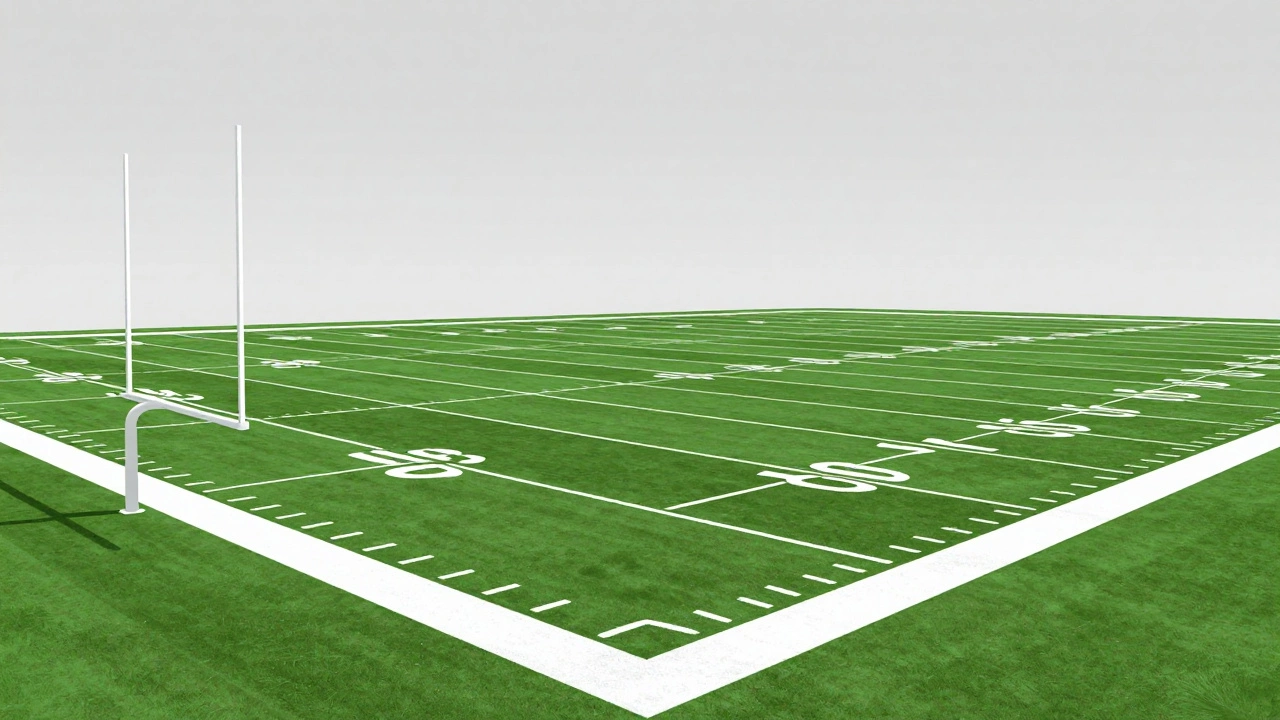
A standard American football field, including the two end zones, measures 120 yards long by 53.3 yards wide. In feet, that is 360 feet by 160 feet. Multiply those together, and you get 57,600 square feet per field. When you divide the total square footage of 100 acres (4,356,000 sq ft) by the square footage of one football field (57,600 sq ft), you get roughly 75.6 fields. Rounding up, we say 76 fields.
If you exclude the end zones and only count the playing surface (100 yards by 53.3 yards), the field is smaller-about 53,328 square feet. In this case, 100 acres would cover about 81.7 football fields. For most general comparisons, however, using the full field with end zones is the standard convention because it represents the total footprint of the stadium structure.
Visualizing 100 Acres in Real Life
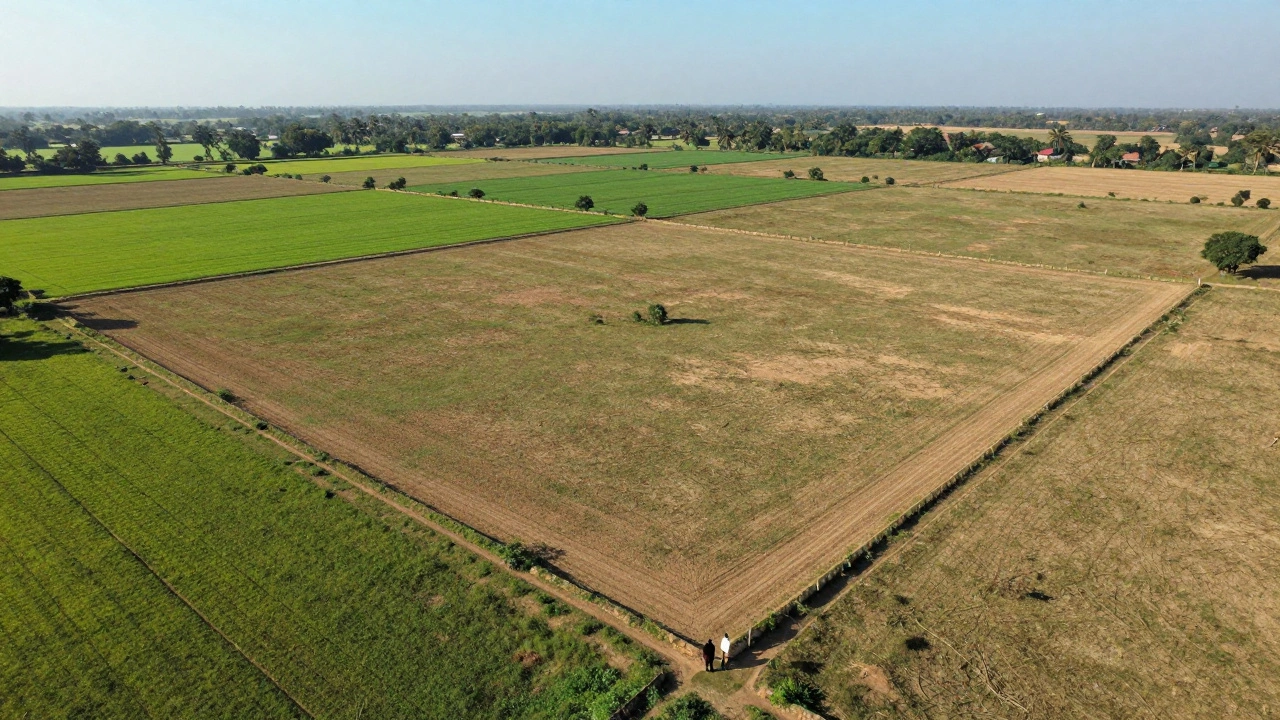
Numbers are useful, but mental images stick better. If you laid out 76 football fields side-by-side, they would form a massive rectangle. To make this easier to picture, let’s look at the shape of 100 acres if it were a perfect square.
A square 100-acre parcel has sides that are each about 2,087 feet long. That is roughly 0.4 miles on each side. If you walked around the perimeter of this square, you would walk nearly 1.6 miles. Now, imagine a soccer pitch. A standard FIFA soccer field is slightly smaller than an American football field, roughly 110 meters by 64 meters. On a 100-acre plot, you could fit approximately 90 soccer pitches.
Consider urban landmarks. The National Mall in Washington, D.C., covers about 250 acres. So, 100 acres is less than half the size of the entire Mall. Central Park in New York City spans 843 acres. Your 100-acre plot is roughly one-eighth the size of Central Park. These comparisons help ground the scale. It isn’t just a backyard; it’s a significant tract of land that requires serious planning to manage.
| Unit of Measurement | Quantity | Notes |
|---|---|---|
| American Football Fields (with end zones) | ~76 | Standard comparison for US audiences |
| Soccer Pitches | ~90 | FIFA standard size |
| Tennis Courts | ~2,700 | US Open doubles court size |
| Miles Per Side (Square) | 0.4 miles | Walkable distance |
| Hectares | 40.5 | Metric system equivalent |
Why Shape Matters More Than Size
When you buy land, the number of acres tells you the volume, but the shape tells you the value. Two plots can both be 100 acres, yet offer completely different usability. A square plot is generally more valuable because it maximizes interior space and minimizes boundary disputes. Every foot of the interior is accessible from multiple directions.
Imagine a 100-acre plot that is one mile long and 528 feet wide. This "long and skinny" shape is common in rural areas near roads. While the acreage is identical, the utility changes drastically. You might have great road frontage, but the back 90 acres could be difficult to access without cutting trails through the middle. Conversely, a circular or square plot allows for efficient irrigation systems, fence lines, and building placement.
For agricultural buyers, shape affects machinery efficiency. Turning tractors takes time and fuel. On a square 100-acre farm, you minimize turns. On an irregularly shaped plot with many nooks and crannies, you lose productivity to maneuvering. Always ask for a plat map before making an offer. The visual representation of boundaries reveals constraints that the acreage number hides.
Implications for Land Development
If you are looking at land for sale with the intent to build, 100 acres offers substantial flexibility. Zoning laws vary wildly by county, but generally, residential zoning might allow one home per 5 to 10 acres. This means a 100-acre parcel could potentially support 10 to 20 homes, depending on local regulations.
Commercial developers often look at density ratios. If you plan to build a subdivision, you must account for infrastructure. Roads, utilities, drainage ponds, and green spaces typically consume 20% to 30% of the total acreage. So, from 100 acres, you might only have 70 to 80 acres available for actual construction. Knowing that 100 acres equals 76 football fields helps you visualize the remaining buildable area after subtracting necessary amenities.
Environmental factors also play a role. Wetlands, steep slopes, and protected tree lines cannot be built upon. A 100-acre lot with 20 acres of wetlands effectively reduces your usable space to 80 acres. During due diligence, hire a surveyor to identify these constraints. The difference between a developable 100 acres and a constrained 100 acres can mean millions of dollars in lost potential revenue.
Agricultural and Recreational Use
For farmers, 100 acres is a manageable mid-sized operation. It is large enough to achieve economies of scale with modern equipment but small enough to manage without a massive corporate workforce. Crop yields vary, but 100 acres of corn or soybeans can generate significant income. However, soil quality matters more than sheer size. Ten acres of prime topsoil will outperform 100 acres of rocky, acidic dirt.
Hunters and outdoor enthusiasts often seek 100-acre parcels for privacy and game management. At this size, you can create diverse habitats. You might clear 10 acres for food plots, leave 40 acres as timber, and maintain 50 acres as open pasture. This diversity attracts deer, turkey, and other wildlife. The key is managing the edges-the transition zones between different types of vegetation-where most wildlife activity occurs.
Recreational use also includes equestrian activities. A horse owner typically needs 2 to 4 acres per horse to prevent overgrazing and parasite buildup. On 100 acres, you could theoretically support 25 to 50 horses, though practical limits regarding water sources, fencing costs, and labor usually reduce this number significantly. Always check local ordinances regarding livestock density.
Cost Considerations and Valuation
Pricing for land is not uniform. Urban fringe land commands higher prices per acre due to proximity to markets and infrastructure. Remote rural land is cheaper but may lack power, water, or internet connectivity. When evaluating price, calculate the cost per acre and compare it to recent sales in the same county.
Remember that buying 100 acres often involves higher closing costs than a typical house purchase. Transfer taxes, recording fees, and title insurance premiums scale with the property value. Additionally, property taxes are based on assessed value, which can jump once you improve the land with buildings or wells. Budget for ongoing maintenance. Mowing 100 acres of grass requires specialized equipment and regular fuel purchases. Fencing that much perimeter is a major upfront investment.
Next Steps for Serious Buyers
If you are considering purchasing 100 acres, start with a clear purpose. Are you investing for future appreciation, building a homestead, or creating a recreational retreat? Your goal dictates the location and shape you need. Next, verify the legal description. Ensure there are no easements that would block your access or limit your building rights. Finally, visit the site at different times of the day. Sunlight patterns, noise levels, and neighbor proximity can change your perception of the space dramatically.
Understanding that 100 acres is roughly 76 football fields gives you a baseline, but the true value lies in how you intend to use that space. Whether you are planting crops, building homes, or preserving nature, the scale of 100 acres provides a canvas large enough for ambitious plans, provided you do your homework first.
How many football fields are in 1 acre?
One acre is approximately 0.76 of an American football field (including end zones). Since an acre is 43,560 square feet and a football field is 57,600 square feet, you need about 1.32 acres to cover one full football field.
What does 100 acres look like in miles?
If 100 acres forms a perfect square, each side is approximately 0.4 miles long. The total perimeter would be about 1.6 miles. This helps you understand the walking distance around the property boundary.
Is 100 acres considered a large farm?
Yes, 100 acres is considered a medium-sized farm. It is large enough to support commercial crop production or a significant number of livestock, but small enough to be managed by a family or small team without industrial-scale operations.
How much does 100 acres of land cost?
The cost varies widely by location. Rural land might cost $1,000 to $5,000 per acre, totaling $100,000 to $500,000. Land near cities or with high development potential can cost $10,000 to $50,000+ per acre, pushing the total price well over $1 million.
Can I build a house on 100 acres?
In most cases, yes. Most zoning laws require a minimum of 1 to 5 acres for a single-family home. With 100 acres, you have ample space for a main residence, guest houses, barns, and extensive landscaping, subject to local building codes and environmental restrictions.