How Much House Can You Afford with a $2,000 Monthly Budget?
Apr, 7 2026
Mortgage Affordability Calculator
Estimated Maximum Home Price:
The Reality of a $2,000 Monthly Budget
You've set a hard limit: $2,000 a month for your housing costs. It sounds like a solid number, but the gap between a monthly payment and a total home price is where most people get tripped up. If you're thinking that $2,000 a month equals a $400,000 home, you're forgetting that the bank doesn't just collect interest. You're juggling principal, taxes, insurance, and potentially private mortgage insurance (PMI). In today's market, your actual borrowing power is usually lower than a simple multiplication table would suggest.
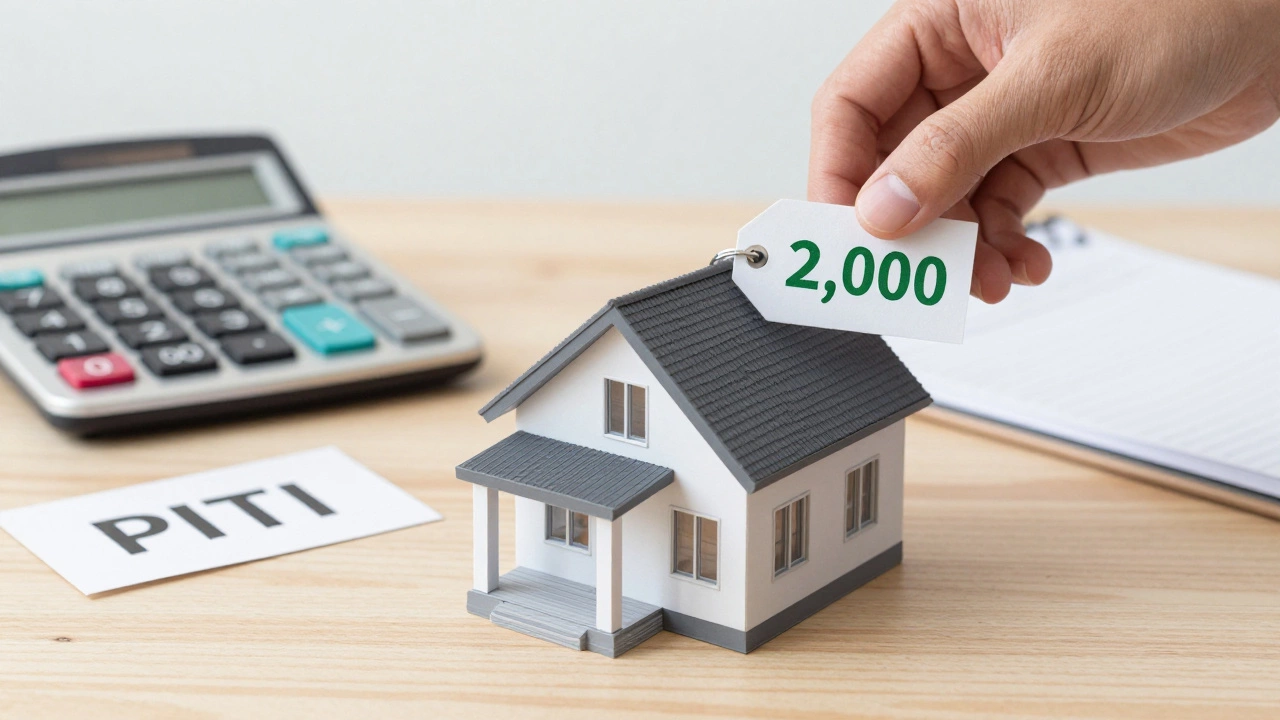
To get a real answer, we have to look at the PITI formula: Principal, Interest, Taxes, and Insurance. If your total budget is $2,000, you aren't putting the full amount toward the loan. You might only be putting $1,400 toward the actual loan, while the rest vanishes into escrow for the government and insurance companies.
Breaking Down the Monthly Payment
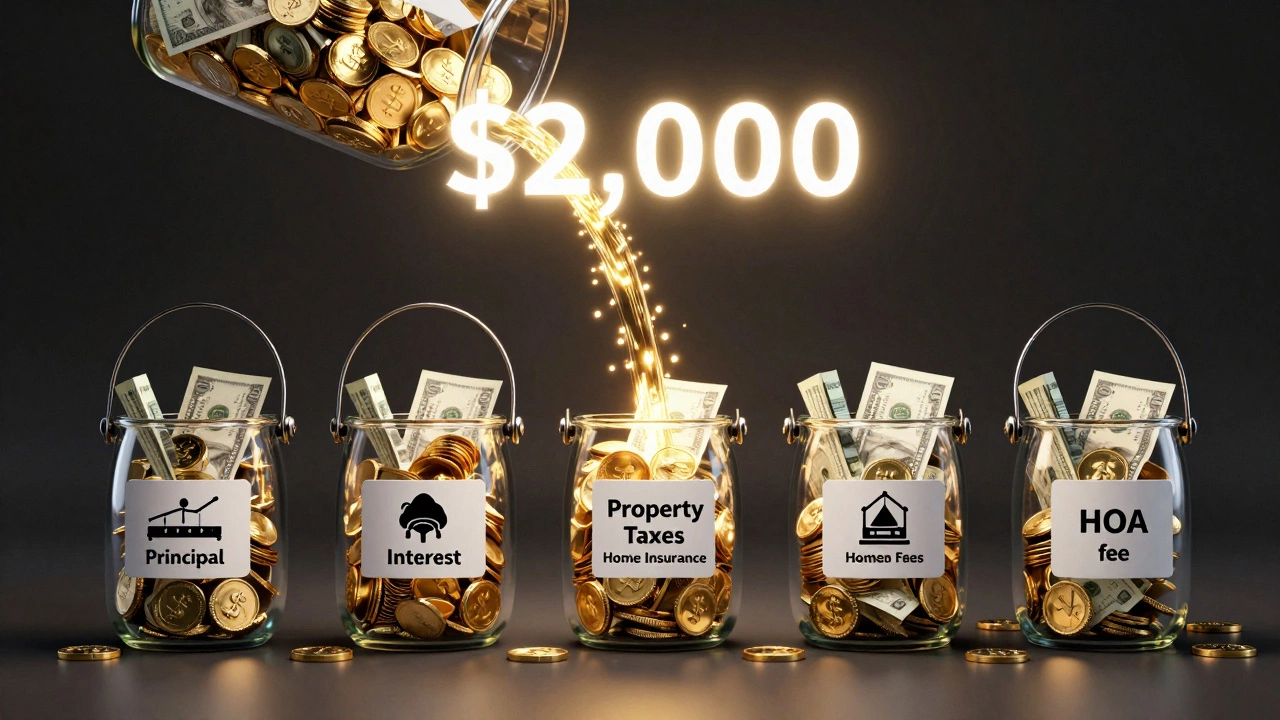
Let's get specific. When you pay $2,000 a month, that money is split into several buckets. If you ignore these, you'll find yourself bidding on houses you can't actually afford.
- Principal and Interest: This is the core of your loan. The principal pays off the balance, and the interest is the cost of borrowing.
- Property Taxes: Depending on where you live, this can be a killer. In states like New Jersey, taxes are sky-high; in others, they're negligible. On average, expect this to eat 1% to 2% of the home's value annually.
- Homeowners Insurance: You can't get a loan without it. Rates vary based on the home's age and location (e.g., flood zones in Florida cost way more than a suburb in Ohio).
- Private Mortgage Insurance (PMI): If you put down less than 20%, the lender protects themselves with PMI. This is a pure expense that adds no value to your equity.
- HOA Fees: If you're buying a condo or a home in a managed community, that monthly fee comes out of your $2,000 budget, not your separate spending money.
Calculating the Purchase Price
How much house does this actually buy? To figure this out, we have to make some assumptions about current market conditions. Let's assume a 6.5% interest rate, a 30-year fixed term, and a 10% down payment. If we earmark $500 of your $2,000 budget for taxes and insurance, you have $1,500 left for the loan principal and interest.
Using these numbers, a mortgage affordability calculation puts your loan amount at roughly $235,000. With your 10% down payment (about $26,000), you're looking at a total purchase price of approximately $261,000.
| Interest Rate | Estimated Loan Amount | Estimated Home Price (10% Down) | Monthly P&I Component |
|---|---|---|---|
| 5% | $270,000 | $300,000 | $1,440 |
| 6.5% | $235,000 | $261,000 | $1,480 |
| 8% | $205,000 | $228,000 | $1,500 |
As you can see, interest rates move the needle significantly. A 1.5% drop in rates could potentially increase your buying power by $40,000. This is why many buyers wait for rate drops or opt for a Rate Buy-down, where the seller pays points to lower the buyer's interest rate for the first few years.
The Impact of Your Down Payment
The amount of cash you bring to the table changes the game. If you have $100,000 in a high-yield savings account and put that toward a home, your $2,000 monthly budget suddenly allows you to buy a much more expensive property. Why? Because you're borrowing less.
For example, if you want a $400,000 home but can only afford $1,500 for the loan payment (after taxes/insurance), you'd need a down payment of about $165,000 to make the math work. The larger the down payment, the less the interest rate hurts you, and the sooner you eliminate the burden of PMI.
Many first-time buyers look at FHA Loans, which allow for down payments as low as 3.5%. While this gets you into a home faster, it increases your monthly payment because the loan amount is higher and the PMI is mandatory until you hit 20% equity.
Hidden Costs That Kill Your Budget
The $2,000 limit usually covers the mortgage, but owning a home isn't like renting. You don't have a landlord to call when the water heater explodes. Experts suggest budgeting 1% of the home's value per year for maintenance. On a $260,000 home, that's $2,600 a year, or about $216 a month. If that $216 has to come out of your $2,000, your actual mortgage capacity drops further.
Then there's the closing cost shock. When you buy a property, you'll pay 2% to 5% of the home price in closing costs. This includes loan origination fees, title insurance, and government recording fees. For a $260,000 home, you might need another $7,000 to $12,000 in cash just to sign the papers.
Strategies to Increase Your Buying Power
If the numbers above feel too low for your area, you have a few levers to pull. You can't change the market, but you can change how you approach the loan.
- Adjust the Loan Term: While 30 years is standard, some people look at adjustable-rate mortgages (ARMs). These often have lower initial rates, giving you more buying power today, though they carry the risk of payments jumping in 5 or 7 years.
- Shop for Different Locations: A $260,000 budget gets you a three-bedroom house in the Midwest, but maybe only a studio apartment in San Francisco. Expanding your search to the outskirts of a city can drastically increase the square footage you get for the same $2,000.
- House Hacking: Consider a duplex or a home with a finished basement. If you can rent out a room for $500 a month, you can effectively increase your budget to $2,500, which adds tens of thousands to your borrowing limit.
- Improve Your Credit Score: A score of 760+ gets you the best rates. Even a 0.25% difference in interest can save you $30 to $50 a month, which adds up over 30 years.
Common Pitfalls to Avoid
The biggest mistake buyers make is getting "pre-approved" for a loan that is higher than their comfortable monthly payment. A bank might tell you that you qualify for a $350,000 loan based on your salary, but that doesn't mean you want to spend $2,600 a month. Stick to your $2,000 limit regardless of what the bank says.
Another trap is ignoring the Debt-to-Income (DTI) Ratio. Lenders typically want your total debt (mortgage + car loans + student loans) to be under 36% to 43% of your gross monthly income. If you have a large car payment, it directly subtracts from how much house the bank will let you buy, even if you feel you can afford the $2,000 payment.
Does the $2,000 include property taxes?
In a realistic budget, yes. Most homeowners pay their taxes and insurance through an escrow account managed by the lender. If you don't include these in your $2,000 limit, you could end up with an actual monthly cost of $2,400 or more, depending on your local tax rate.
What happens if I put 20% down instead of 10%?
Putting 20% down does two things: it lowers the amount you need to borrow and it completely removes the need for Private Mortgage Insurance (PMI). This significantly lowers your monthly payment, allowing you to either buy a more expensive home or keep your payment well under $2,000.
Can I buy a house with $0 down and still keep a $2,000 payment?
Yes, through programs like VA loans (for veterans) or USDA loans (for rural properties). However, because you are borrowing 100% of the home's value, your loan amount must be much smaller to keep the payment at $2,000. You would likely be looking at homes in the $200,000 to $220,000 range.
How do interest rates affect my budget?
Interest rates are the most volatile part of the equation. A 1% increase in the annual percentage rate (APR) can reduce your buying power by roughly 10%. This means if rates jump, you may have to look for a cheaper house to keep your payment at $2,000.
Are HOA fees included in the $2,000?
If you are buying a condo or a townhome, HOA fees are a mandatory monthly cost. They are not part of the mortgage loan but are part of your housing cost. You must subtract the HOA fee from your $2,000 before calculating how much loan you can afford.