The 2% Rule for Investment Property: A Complete Guide to Real Estate Cash Flow

May, 15 2026
You’ve heard the whispers in every investor group chat. You’ve seen it on every "get rich quick" reel. The 2% rule is a heuristic used by real estate investors to determine if a rental property will generate sufficient cash flow relative to its purchase price. It sounds simple: if your monthly rent covers at least 2% of the total acquisition cost, you buy it. If not, you walk away.
But here’s the catch. In today’s market, especially with interest rates hovering where they are in 2026, strictly following this rule might mean you never buy anything. Or worse, you miss out on massive equity growth because you were too focused on immediate cash flow. Let’s cut through the noise. Does the 2% rule still work? When should you ignore it? And how do you actually calculate whether a deal is good?
The Math Behind the Myth
To understand why people love or hate the 2% rule, you have to look at the math. It’s brutally simple. Take the total price you pay for the property-including closing costs-and multiply it by 0.02. That number is your minimum monthly gross rent.
Here is a concrete example. Let’s say you find a duplex in a mid-sized city. The list price is $300,000. You plan to spend another $10,000 on closing costs and initial repairs. Your total acquisition cost is $310,000.
- Total Cost: $310,000
- 2% Calculation: $310,000 × 0.02 = $6,200
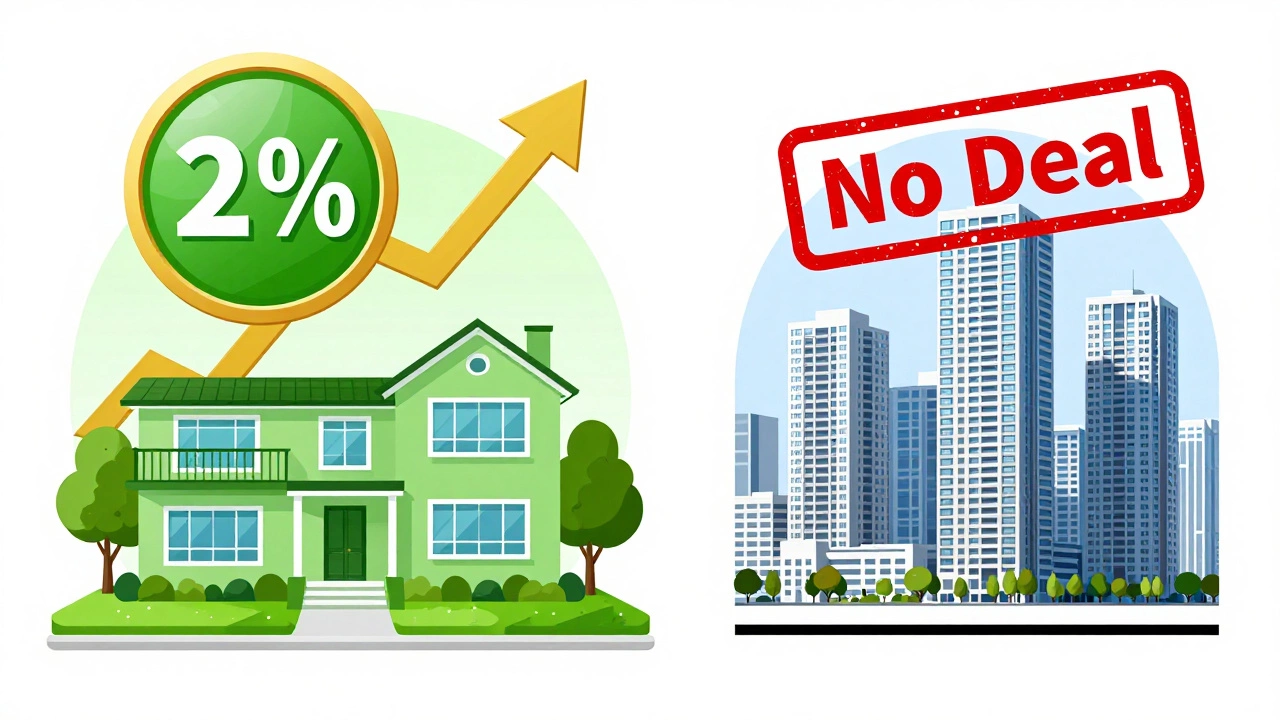
Under the strict 2% rule, you need that property to bring in $6,200 per month before you even think about expenses. If the comparable rentals in the neighborhood are only pulling $4,500, the rule says "no deal."
Why did this rule become popular? Because it guarantees positive cash flow from day one. In high-appreciation markets like Los Angeles or San Francisco, finding a property that rents for 2% of its value is nearly impossible. A $1 million home there would need to rent for $20,000 a month. That doesn’t exist for residential units. So, investors in hot markets often abandon the rule entirely, relying instead on appreciation and leverage.
Gross Rent vs. Net Income: The Hidden Trap
The biggest flaw in the 2% rule is that it looks at Gross Rent Potential (GRP), not what actually hits your bank account. It ignores the vacuum cleaner, the plumber, the tax man, and the empty months when no tenant signs.
If you buy that $310,000 property and rent it for $6,200, you feel safe. But let’s run the numbers on the expenses that eat into that profit:
| Expense Category | Estimated Cost | Notes |
|---|---|---|
| Mortgage Payment | $1,800 | Assuming 20% down, 7% interest rate |
| Property Taxes | $900 | Varies heavily by county |
| Insurance | $200 | Hazard and liability coverage |
| Maintenance Reserve | $600 | 10% of gross rent rule of thumb |
| Vacancy Rate | $620 | 10% vacancy allowance |
| Management Fee | $620 | 10% if using a property manager |
Add those up, and your expenses are roughly $4,740. Your cash flow is $6,200 - $4,740 = $1,460. That’s positive, sure. But if the rent was only $5,500 (which is more realistic), your cash flow drops to $760. Is $760 worth the headache of being a landlord? Maybe. Maybe not. The 2% rule doesn’t tell you that. It just tells you the rent is high enough to cover costs *if* costs stay low.
When the 2% Rule Actually Works
Don’t throw the baby out with the bathwater. The 2% rule is incredibly useful in specific scenarios. It shines brightest in markets where prices haven’t skyrocketed but rents remain strong relative to home values. Think of smaller towns, rural areas, or emerging cities in the Midwest or South.
In these "cash flow markets," appreciation might be slow-maybe 2-3% a year-but the monthly income is robust. This is ideal for investors who need immediate passive income to pay their own mortgage or retirement bills. It’s also great for beginners who want a wide margin of error. If something goes wrong-a roof leaks, a tenant stops paying-the extra cash cushion keeps you from bleeding money.
Additionally, the rule works well for all-cash purchases. If you aren’t paying a mortgage, your expenses drop significantly. A property renting for 1.5% of its value might still be a fantastic deal if you own it outright, because your net operating income (NOI) is much higher.
Alternatives to the 2% Rule
Since the 2% rule is so rigid, many seasoned investors use other metrics to evaluate deals. These methods provide a more nuanced view of profitability.
The 1% Rule
This is the modern compromise. Many investors accept a 1% return on the purchase price as a baseline for cash-flowing properties in appreciating markets. If you buy a $500,000 condo, you expect $5,000/month in rent. It’s harder to hit than 2%, but it’s possible in urban centers. The trade-off is lower monthly cash flow, but higher potential for long-term equity growth.
Cash-on-Cash Return
This metric measures the actual return on the cash you invested. It’s calculated by dividing your annual pre-tax cash flow by the total amount of cash you invested (down payment + closing costs + rehab).
If you put $100,000 down on a property and it generates $8,000 in annual cash flow, your cash-on-cash return is 8%. This is often a better indicator of performance than the 2% rule because it accounts for your leverage. A higher loan-to-value ratio means less cash invested, which can boost this percentage even if the rent isn’t 2% of the price.
Cap Rate (Capitalization Rate)
Cap rate is the gold standard for comparing different properties. It’s the Net Operating Income (NOI) divided by the current market value. NOI is the gross rent minus all operating expenses (but excluding mortgage payments). A cap rate of 5% is generally considered average for stable markets, while 8% or higher indicates a high-yield, potentially riskier investment. Cap rate allows you to compare a cheap house in Detroit with an expensive apartment in New York on an equal footing.

How to Calculate Your Own Threshold
Instead of blindly following the 2% rule, create your own benchmark based on your goals. Ask yourself three questions:
- What is my required cash flow? Do you need $500 a month to break even, or $2,000 to live off?
- What is my exit strategy? Are you holding for 30 years (appreciation focus) or flipping in 3 years (cash flow focus)?
- What is the local vacancy rate? In some cities, vacancies last weeks. In others, they last months. Adjust your expected rent downward by 5-10% to be safe.
For example, if you’re in a high-appreciation area like Los Angeles, you might set a rule of: "Rent must cover 50% of my mortgage plus all expenses." This ensures you don’t lose money each month, even if the rent isn’t 2% of the value. You’re betting on the asset’s value going up, not just the monthly check.
Risks of Ignoring the Rules
While flexibility is good, ignoring basic financial principles is dangerous. The biggest risk is negative cash flow. If your expenses exceed your income, you’re subsidizing your tenant. Over time, this drains your savings and limits your ability to buy more properties.
Another risk is over-leveraging. If you stretch your budget to buy a property that barely breaks even, one major repair (like a new HVAC system costing $10,000) can wipe out a year’s worth of profits. Always keep a reserve fund. The 2% rule, when applicable, builds this reserve naturally. Without it, you must be disciplined about saving.
Is the 2% rule outdated in 2026?
Yes, for most major metropolitan areas. Due to high property prices and moderate rent growth, hitting 2% is extremely difficult in cities like NYC, LA, or SF. However, it remains a valid benchmark for rural properties, small towns, and all-cash investments where cash flow is the primary goal.
Does the 2% rule include mortgage payments?
No. The 2% rule is based on gross rent versus total acquisition cost. It does not account for financing costs, taxes, insurance, or maintenance. It is a rough screening tool, not a detailed pro forma analysis.
Can I use the 2% rule for commercial real estate?
It’s less common. Commercial real estate is typically evaluated using Cap Rates and Net Operating Income (NOI). Tenants in commercial leases often pay for some expenses (NNN leases), which changes the math. Stick to Cap Rates for commercial deals.
What is a good cash-on-cash return?
Aim for at least 8-10% annually. This provides a buffer against unexpected expenses and inflation. If your return is below 5%, you might be better off investing in index funds, which require less effort and carry less risk.
Should I prioritize cash flow or appreciation?
It depends on your timeline. If you need income now, prioritize cash flow (and look for the 2% rule). If you are young and building long-term wealth, prioritize appreciation and location, accepting lower initial cash flow. Most successful investors balance both.