What Is a Good Cap Rate for Commercial Real Estate in 2026?
Feb, 10 2026
Cap Rate Calculator
Cap Rate Calculator
Calculate your property's cap rate and see how it compares to current market standards.
Market Context
According to Q1 2026 data:
6-7%: Class A properties in major metros
7.5-8.5%: Sweet spot for most investors
9% and above: Higher-risk opportunities
Key Market Benchmarks
| Market | Office | Retail | Industrial | Multi-Family |
|---|---|---|---|---|
| Los Angeles | 6.2% | 7.0% | 8.1% | 5.8% |
| Chicago | 6.8% | 7.4% | 8.6% | 6.1% |
| Phoenix | 7.5% | 8.0% | 9.2% | 6.7% |
| Atlanta | 7.1% | 7.8% | 8.9% | 6.4% |
| Minneapolis | 7.9% | 8.5% | 9.4% | 6.9% |
Note: Industrial properties consistently show higher cap rates due to supply chain volatility. Always consider market-specific factors.
When you're looking at a commercial property - an office building, a retail strip center, or even a warehouse - one number tells you more than any brochure or listing photo: the cap rate. It’s not just jargon. It’s the heartbeat of the deal. But what’s actually a good cap rate? And why does it matter so much when you’re deciding whether to buy or walk away?
What Exactly Is a Cap Rate?
The capitalization rate, or cap rate, is a simple formula: Net Operating Income (NOI) divided by Property Value. You don’t need a finance degree to get it. If a building brings in $120,000 a year after all expenses - taxes, maintenance, management, vacancies - and you’re looking at a $1.2 million price tag, the cap rate is 10%. That’s $120k ÷ $1.2M = 0.10, or 10%.
Think of it like this: if you paid cash for the property, the cap rate is your annual return. No mortgage. No loans. Just pure cash flow. That’s why investors use it to compare apples to apples. A 7% cap rate in downtown Los Angeles might be solid. In rural Ohio, it could be a red flag.
What’s Considered a ‘Good’ Cap Rate Right Now?
In early 2026, the market has shifted. Interest rates are holding steady around 5.5%, inflation is cooling, and tenants are more selective. So what’s a good number?
- 6% to 7% - This is the new baseline for Class A properties in major metros like LA, NYC, or Chicago. Think brand-new office towers with Fortune 500 tenants. Low risk. Low reward.
- 7.5% to 8.5% - The sweet spot for most investors. You’ll find this in well-maintained retail centers, medical office buildings, or industrial spaces in growing suburbs. Solid demand. Manageable vacancies.
- 9% and above - These are higher-risk plays. Older buildings. Less stable tenants. Markets with economic headwinds. But they can pay off big if you know what you’re doing. In parts of Texas or Georgia, 9.5% cap rates on industrial buildings are common.
Don’t chase numbers blindly. A 10% cap rate on a 1980s retail center with 40% vacancy? That’s not a bargain. That’s a money pit. A 6.5% cap rate on a fully leased Amazon warehouse with a 15-year lease? That’s a steal.
Location Changes Everything
Cap rates aren’t universal. They’re local. In Los Angeles, a 7% cap rate on a retail center in Santa Monica is normal. In Phoenix, the same building might trade at 8.2%. Why? Because in LA, demand is high, land is scarce, and construction costs are through the roof. In Phoenix, supply is up, but demand is still growing - so prices haven’t caught up.
Here’s what’s happening in key markets as of early 2026:
| Market | Office | Retail | Industrial | Multi-Family |
|---|---|---|---|---|
| Los Angeles | 6.2% | 7.0% | 8.1% | 5.8% |
| Chicago | 6.8% | 7.4% | 8.6% | 6.1% |
| Phoenix | 7.5% | 8.0% | 9.2% | 6.7% |
| Atlanta | 7.1% | 7.8% | 8.9% | 6.4% |
| Minneapolis | 7.9% | 8.5% | 9.4% | 6.9% |
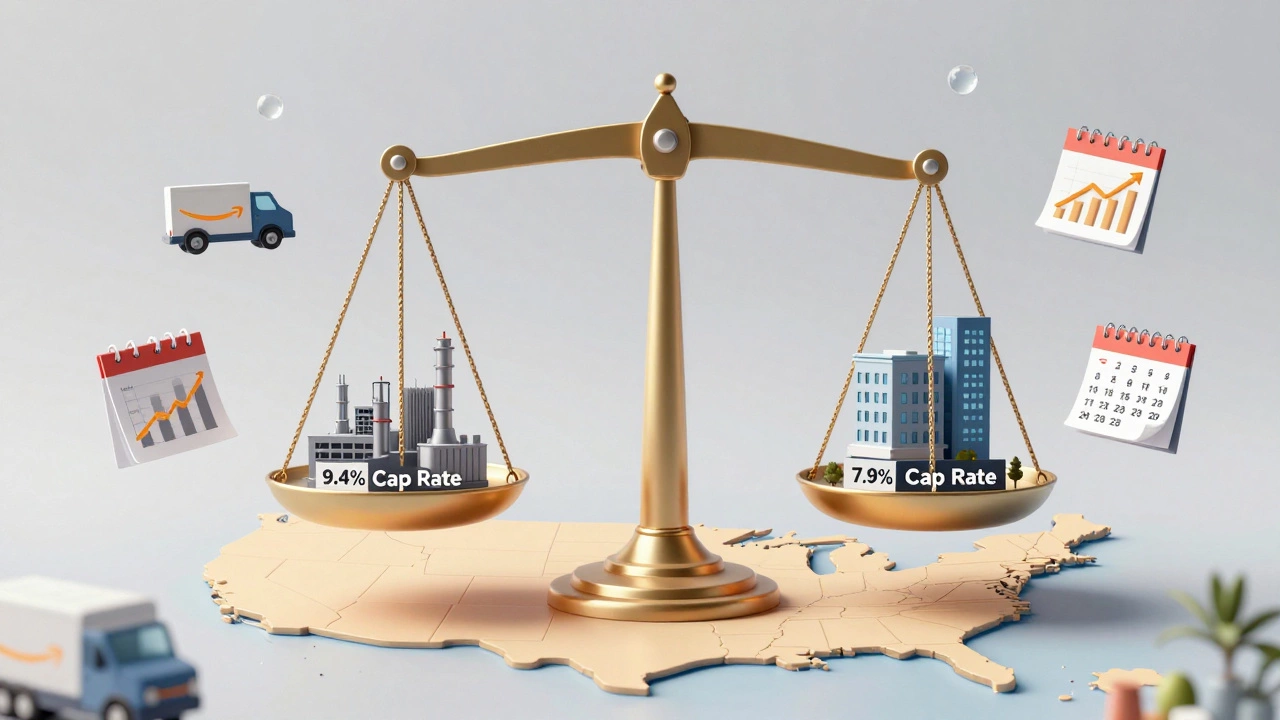
Notice how industrial cap rates are higher across the board? That’s because supply chain shifts have made warehouses more valuable - but also more volatile. If Amazon shifts its distribution network, your 9.5% cap rate could drop fast.
What Drives Cap Rates Up or Down?
It’s not magic. It’s math - and psychology.
- Higher cap rates usually mean higher risk: older buildings, shorter leases, tenants with shaky credit, or markets with population decline.
- Lower cap rates mean safety: long-term leases with investment-grade tenants (think Target, CVS, or FedEx), modern infrastructure, and strong job growth.
Interest rates matter too. When rates climb, cap rates climb with them - because buyers need higher returns to justify the cost of money. In 2023, when rates hit 5.8%, cap rates jumped across the board. Now that they’ve stabilized, we’re seeing a slow correction. Buyers are more cautious. Sellers are holding out. That’s why you’re seeing fewer deals - but the ones that close are more carefully priced.
Red Flags to Watch For
Here’s what you need to dig into before you sign anything:
- Lease expirations - If 60% of your tenants are leaving in 18 months, a 9% cap rate looks great - until you realize you’ll need to spend $200k on tenant improvements and six months of vacancy.
- Expense inflation - Property taxes in California jumped 12% last year. Insurance? Up 20%. If your NOI doesn’t account for that, your cap rate is fake.
- Market oversupply - A new warehouse district popping up down the road? That’s not a growth story. It’s a cap rate killer.
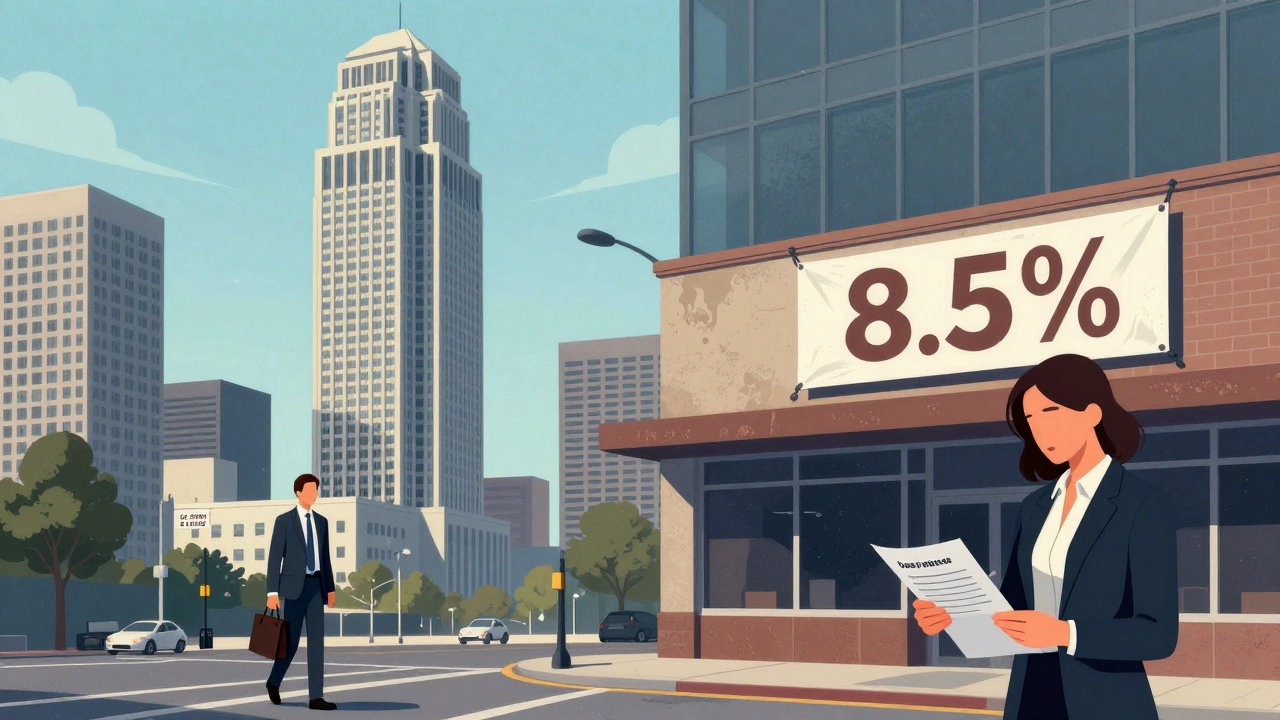
One client in Riverside bought a 9.1% cap rate retail center in 2024. Three months later, a competitor opened a brand-new shopping plaza 2 miles away. Vacancy jumped to 35%. The cap rate didn’t just drop - it vanished. That’s why you don’t just look at the number. You look at the story behind it.
How to Use Cap Rate to Your Advantage
Cap rate isn’t just a metric. It’s a decision tool.
- Compare deals - Two buildings with similar square footage? Pick the one with the higher cap rate - but only if the quality is comparable.
- Spot undervalued assets - If a property’s cap rate is 2% higher than similar buildings in the area, there’s a reason. Maybe the owner is desperate. Maybe the building needs a facelift. That’s your opening.
- Validate your offer - If you’re offering $1.5M for a property with $110k NOI, your cap rate is 7.3%. Is that in line with the market? If not, you’re either overpaying or missing something.
Don’t use cap rate alone. Always pair it with cash-on-cash return (if you’re financing) and internal rate of return (for long-term holds). But cap rate? That’s your first filter. If it doesn’t make sense here, it won’t make sense anywhere.
Final Thought: There’s No Magic Number
A ‘good’ cap rate isn’t a number on a chart. It’s a number that fits your strategy.
If you’re a passive investor looking for steady income? Stick to 7%-8.5% in stable markets. If you’re a hands-on operator who can renovate, re-lease, and reposition? A 9%+ property might be your golden ticket.
And remember: cap rates don’t lie. But they don’t tell the whole story either. The best investors don’t just chase numbers. They chase context.
Is a 5% cap rate good for commercial real estate?
A 5% cap rate is only good if you’re buying in a super-tight market like downtown LA or Manhattan with long-term leases to blue-chip tenants. It’s a low-risk, low-return play. Outside those areas, it’s a sign you’re overpaying. In most markets, you can find better returns without taking on extra risk.
Why are cap rates higher in industrial than in office buildings?
Industrial properties - warehouses, distribution centers - have seen massive demand from e-commerce and reshoring. But they’re also more sensitive to economic shifts. If Amazon cuts back, your tenant might leave. Office buildings, especially in cities, face remote work trends, so they’re riskier. But industrial cap rates are higher because investors demand more return for that volatility.
Can cap rates go negative?
Technically, yes - but only if your expenses exceed your income. That’s a failing property. A negative cap rate means you’re losing money every month. It’s not an investment. It’s a liability. If you see a listing with a negative cap rate, walk away.
How often do cap rates change?
Cap rates shift every time a property sells. But the market average moves slowly - usually every 6 to 12 months. Interest rates, tenant demand, and construction costs drive those changes. In 2025, cap rates rose 0.3% to 0.7% across most asset classes. We’re seeing stability in early 2026.
Should I trust cap rates from online listings?
No. Many brokers inflate NOI by leaving out maintenance, property taxes, or insurance. Always ask for the last 12 months of operating statements. Verify every number yourself. A cap rate you can’t prove is just a sales pitch.