What Value Is Most Commonly Used for Commercial Property? A Guide to Market vs. Book Value

Jun, 16 2026
Commercial Property Valuation Calculator
Calculate the Market Value of a commercial property using the Income Capitalization Approach (NOI / Cap Rate). This method is widely considered the gold standard for stabilized assets.
Estimated Market Value:
Impact of Interest Rates:
- At % cap rate:
- At % cap rate:
You walk into a boardroom with a sleek presentation deck. You’ve got the square footage, the tenant list, and the cap rate ready to go. But when the buyer asks, "So, what is it worth?" you hesitate. Do you quote the price on the tax assessment? The number from your last audit? Or the figure an appraiser just handed you?
It’s a trap many investors fall into. In residential real estate, we often look at comparable sales (comps) as the gospel truth. But in commercial property, real estate held for business purposes or investment rather than personal residence, the definition of "value" splits into several distinct categories. Using the wrong one can cost you millions-or leave money on the table.
If you are buying, selling, or refinancing commercial real estate in 2026, you need to know which metric actually moves the needle. Spoiler alert: It’s rarely the number on your balance sheet.
The Two Main Contenders: Market Value vs. Book Value
To understand what value is most commonly used, we first have to separate the two biggest players in the room: Market Value and the price a willing buyer would pay a willing seller in an open market versus Book Value and the asset's value as recorded on the company's financial statements.
Book Value is an accounting concept. It’s calculated by taking the original purchase price, adding any capital improvements, and subtracting accumulated depreciation. It’s clean, auditable, and boring. For tax purposes and internal accounting, it’s king. But for a transaction? It’s almost useless.
Imagine you bought an office building in Los Angeles ten years ago for $5 million. Over time, you depreciated it for taxes, so its book value might now be $3 million. However, due to inflation and rising demand, similar buildings are selling for $12 million today. If you try to sell based on book value, you’re leaving $9 million on the table. Conversely, if you bought high during a bubble, your book value might be higher than what anyone will actually pay.
Market Value is what buyers and sellers care about. It reflects current supply and demand, interest rates, and the income potential of the property. When a bank lends against a property, they don’t care about your book value; they care about the collateral’s market value.
| Feature | Market Value | Book Value |
|---|---|---|
| Definition | Price determined by current market conditions and comparable sales. | Historical cost minus accumulated depreciation per GAAP standards. |
| Primary Use | Buying, selling, refinancing, and lending decisions. | Tax reporting, auditing, and internal financial statements. |
| Variance | Fluctuates daily with economic indicators and local demand. | Changes slowly over time through depreciation schedules. |
| Who Determines It? | Appraisers, brokers, and market participants. | Accountants and auditors. |
| Relevance in 2026 | High - Drives all transactional activity. | Low - Only relevant for tax basis and equity calculations. |
Why Market Value Wins for Transactions
When the question is "what value is most commonly used for commercial property sale," the answer is unequivocally market value. But why? Because commercial real estate is fundamentally an income-producing asset. Unlike a home, where emotions and lifestyle drive prices, a warehouse or shopping center is a business. Its value is tied directly to its ability to generate cash flow.
This leads us to the three primary methods appraisers use to determine that market value. Understanding these helps you negotiate better because you know how the other side arrived at their number.
- The Sales Comparison Approach: This is the most intuitive method. Appraisers look at recently sold properties similar to yours in size, location, and condition. They adjust for differences. If your building has a newer HVAC system than the comp, they add value. If the comp is closer to a highway, they subtract. In 2026, with data platforms like CoStar and Reonomy providing instant access to thousands of transactions, this approach is more precise than ever.
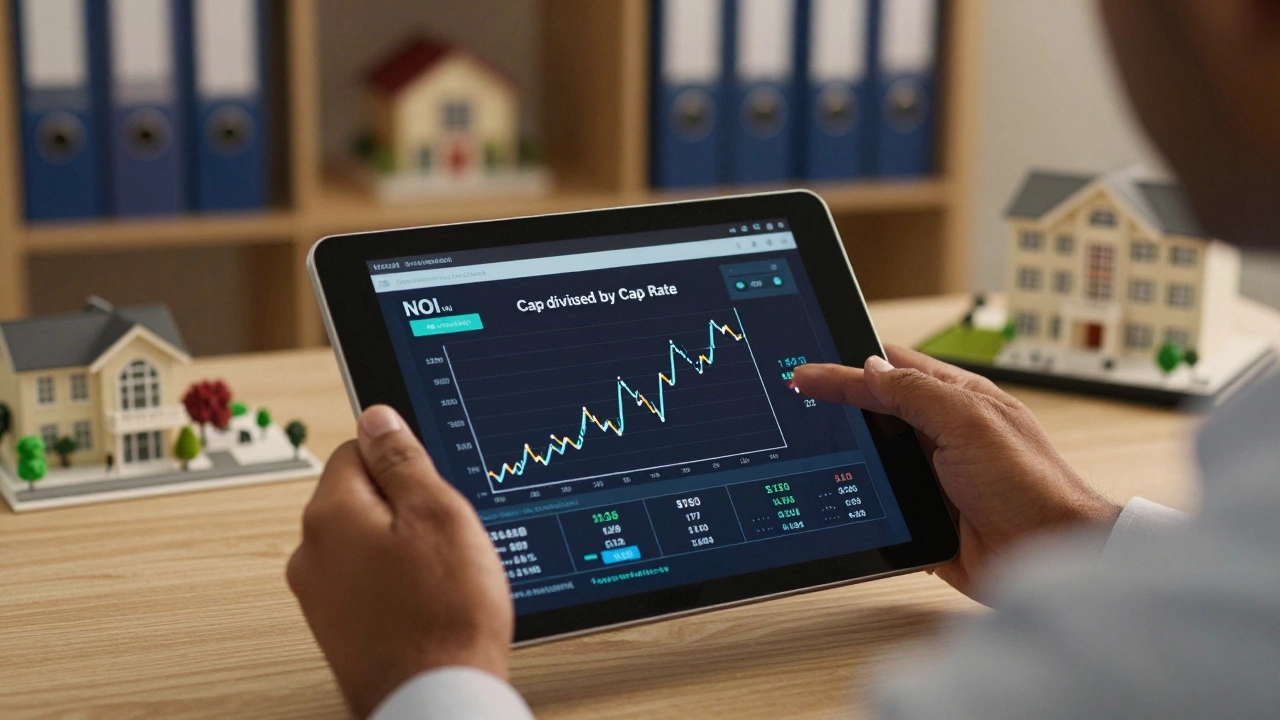
- The Income Capitalization Approach: This is the gold standard for stabilized assets like apartment complexes and office towers. The formula is simple: Net Operating Income (NOI) divided by the Capitalization Rate (Cap Rate). If a building generates $1 million in NOI and the going cap rate for that neighborhood is 5%, the market value is $20 million. Small changes in interest rates or vacancy rates can swing this value dramatically.
- The Cost Approach: This is less common for older properties but vital for new construction or unique facilities like hospitals or schools. It calculates what it would cost to rebuild the structure today, plus the land value, minus physical depreciation. It sets a ceiling on value-rarely will a buyer pay more than the cost to build a replacement.
For most transactions, the Income Approach and Sales Comparison Approach carry the most weight. Lenders require an appraisal using these methods before issuing a loan. Without a verified market value, there is no deal.
Fair Market Value vs. Investment Value
Here’s where it gets tricky. Even within "market value," there are nuances. You might hear the term Fair Market Value (FMV) and the price agreed upon between a willing buyer and seller without undue pressure. This is the legal standard used in divorce settlements, estate taxes, and condemnation cases. It assumes both parties are knowledgeable and acting in their own best interest.
Then there’s Investment Value and the value to a specific investor based on their individual requirements and expectations. This is subjective. For example, if you already own the land next door, a vacant lot might have higher investment value to you because it allows you to consolidate your holdings and increase density. To a stranger, it’s just a piece of dirt.
In a public sale, market value rules. In a private partnership buyout or strategic acquisition, investment value might drive the premium. Always clarify which lens you’re looking through.

The Impact of Interest Rates on Valuation
We cannot talk about commercial property value in 2026 without discussing interest rates. The relationship is inverse and powerful. When interest rates rise, cap rates tend to expand (increase). When cap rates expand, values drop-even if the income stays the same.
Let’s run the numbers. Take that same building generating $1 million in NOI.
- At a 4% cap rate, the value is $25 million.
- At a 5% cap rate, the value drops to $20 million.
- At a 6% cap rate, the value plummets to $16.6 million.
When Book Value Still Matters
While market value drives the sale, book value isn’t dead. It plays a crucial role in two areas:
- Tax Basis: When you sell, you pay capital gains tax on the difference between the sale price and your adjusted basis (closely related to book value). Knowing your book value helps you forecast the tax hit.
- Equity Calculations: Private equity firms often look at the ratio of market value to book value to assess leverage and return on invested capital. If the market value is significantly higher than the book value, it suggests the asset has appreciated substantially since acquisition.
Common Pitfalls in Valuing Commercial Property
Even experienced investors make mistakes. Here are three common errors:
- Ignoring Lease Expirations: A property might look great on paper with high rents, but if 80% of the leases expire in six months, the market value should reflect the risk of vacancy. Discounted Cash Flow (DCF) models account for this; static cap rates do not.
- Misclassifying Property Type: Not all "office" space is equal. Class A tech hubs command different multiples than suburban industrial offices. Using the wrong comparables skews the value.
- Overlooking Environmental Issues: Phase I Environmental Site Assessments are standard. If soil contamination is found, the market value can evaporate overnight due to remediation costs. Never skip this step.
How to Get an Accurate Valuation Today
If you’re preparing to sell or refinance, don’t guess. Hire a certified general appraiser who specializes in your asset class. In Los Angeles, for instance, an appraiser familiar with the nuances of downtown high-rises will give you a far more accurate market value than a generalist who mostly does residential homes.
Additionally, leverage technology. PropTech tools now offer automated valuation models (AVMs) for commercial real estate. While not a substitute for a full appraisal, they provide a quick sanity check. If your broker says the building is worth $30 million, but three different AVMs say $22 million, dig deeper. Something is off.
Finally, remember that value is not static. It’s a snapshot in time. The most commonly used value for commercial property is the one that reflects today’s reality, not yesterday’s hopes or tomorrow’s dreams.
Is assessed value the same as market value?
No. Assessed value is determined by local government authorities for property tax purposes. It often lags behind market value by several years and may be capped by state laws (like Proposition 13 in California). Market value reflects what a buyer will actually pay today.
Which valuation method is best for retail property?
The Income Capitalization Approach is typically best for stabilized retail properties with long-term tenants. However, the Sales Comparison Approach is also heavily weighted, especially for smaller neighborhood centers where recent comps are available.
How often should I get a commercial property appraised?
You should get a formal appraisal whenever you are buying, selling, or refinancing. For portfolio management, an annual review of market conditions and a updated rent roll analysis is recommended to track value trends.
Can market value be lower than book value?
Yes. This happens during market downturns, if the property suffers physical damage, or if the original purchase price was inflated during a bubble. In such cases, the asset is considered "underwater" relative to its historical cost.
What is the role of a Cap Rate in determining value?
The Cap Rate is the expected rate of return on a real estate investment. It acts as the divisor in the valuation formula (Value = NOI / Cap Rate). Lower cap rates indicate higher values and lower perceived risk, while higher cap rates indicate lower values and higher risk.